
Rio de Janeiro paper plane game
Ride the cable car up Sugarloaf Mountain.
The hills come up fast. Get past the cable car, then the samba dancer.


The River of January
Portuguese sailors entered its bay in January 1502 and, taking it for a river mouth, named it Rio de Janeiro, "River of January". From 1808 the Portuguese court ruled its empire from here, the only time a European capital sat outside Europe. It stayed Brazil's capital until 1960.
“I'd sail into the bay and mistake it too.”
The landmarkSugarloaf Mountain
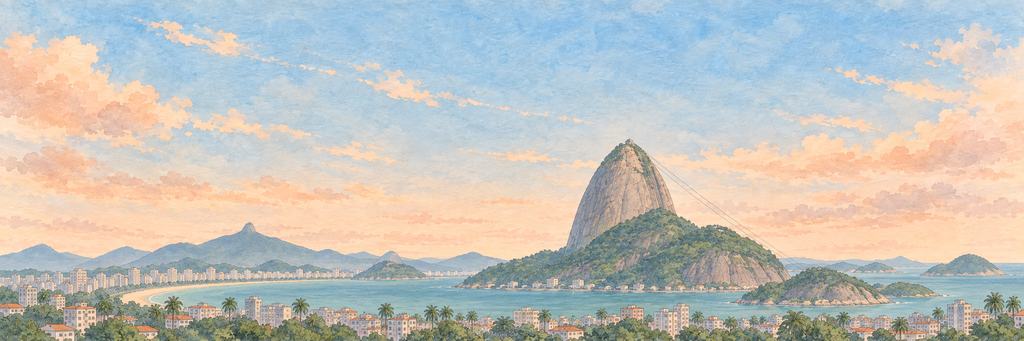
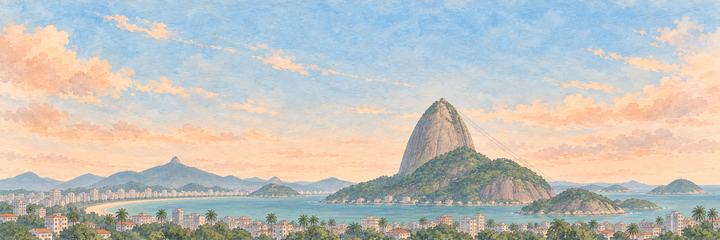
Sugarloaf is a 396-metre dome of granite and quartz rising straight from the water at the mouth of Guanabara Bay. Its name most likely comes from the cone-shaped clay moulds sugar was shipped in, back when Brazil sold sugar to the world. Climbers still scale its bare rock walls.
Neighbourhoods
The city of Rio de Janeiro had about 6.2 million people in the 2022 census. In Ipanema, in 1962, Tom Jobim and Vinicius de Moraes wrote "The Girl from Ipanema" at a bar on Montenegro Street, as they watched a local girl walk by to the beach. Nearer the centre, the old aqueduct called the Arcos da Lapa has 42 arches in two rows. It was opened in 1750 to bring fresh water to the city. Since the late 19th century it has carried the yellow tram up to the hilltop district of Santa Teresa.
The coast and the bay
Copacabana's promenade runs for about 4 km beside the beach. In 1970 Roberto Burle Marx laid out its pavement of black and white stones in a wave pattern, taken from old Portuguese paving. Across Guanabara Bay, the Rio–Niterói Bridge opened on 4 March 1974. It is 13.29 km long, and about 8.8 km of it runs over water.
The skyline
Rio's skyline is shaped by its mountains. On top of Corcovado, about 700 metres up, stands Christ the Redeemer. The statue is 30 metres tall, its arms reach 28 metres across, and it was finished in 1931. In 2007 it was voted one of the New Seven Wonders of the World. The cable car to Sugarloaf, the first in Brazil, has run since 1912. In 2012 Rio became the first city listed by UNESCO as an urban cultural landscape, for the way its peaks and coast meet.
When to see it
Go to the Arpoador rock, between Copacabana and Ipanema, at sunset. On summer evenings crowds gather there, and many clap when the sun goes down.
Who keeps the wish in Rio de Janeiro.
An Elite wakes first; the Boss guards the wish itself. Hit their weak points for a BONK!, land the last blow for a KO!, and each one grins and takes a bow.
-
The Elite
The Cable Car
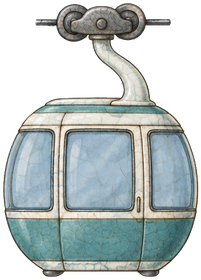
Hangs on by one wire · Keeper of Sugarloaf
When it opened in 1912, the Sugarloaf cable car was, by most counts, only the third passenger cableway in the world, after ones in Spain and Switzerland. Engineer Augusto Ferreira Ramos dreamed it up in 1908. Its first cars were wooden, like Rio's trams, and carried 22 people through the air above Guanabara Bay.
The cable car sways on its wire. The cable car swings hard and rattles on its wire. The cable car stops swinging and hangs still.
“I'd sit by the window and never blink.”
-
The Boss
The Samba Dancer
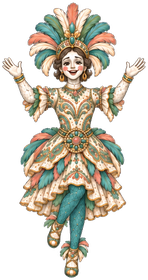
Never misses a beat · Keeper of the Sambadrome
Deixa Falar, "Let Them Talk", often called the first samba school, was founded in Rio's Estácio neighbourhood in 1928 by musicians including Ismael Silva. Since 1984 the schools have paraded through Oscar Niemeyer's Sambadrome, each with thousands of dancers, drummers and towering floats.
The samba dancer starts to spin, feathers and all. The dancer loses a step, then finds the beat again. The dancer finishes the spin and takes a bow.
“I'd dance the whole parade and never stop.”
Rio de Janeiro cleared. The mountain was shaped like a sugar loaf, just like its name.
- The cable car rocked like a swing.
- The dancer kept spinning right up to the bow.
The plane reaches Rio de Janeiro from New York. Its own plane look is Carnival Confetti, a trail look.