
Beijing paper plane game
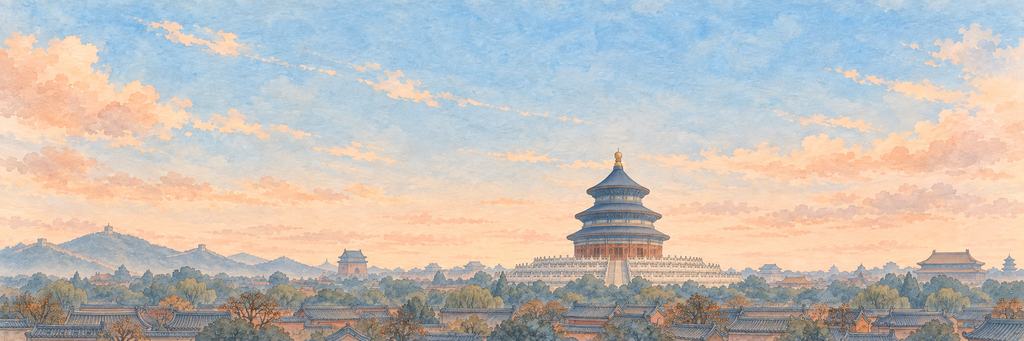
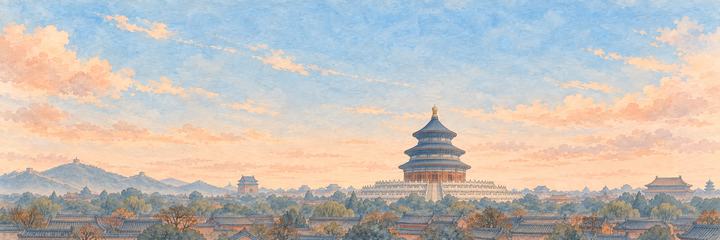
See the round blue roofs of the Temple of Heaven.
Fly level over the hutong roofs. Get past the palace lion, then the Xiezhi.


The northern capital
Kublai Khan built his capital, Dadu, here from 1267. In 1403 the Ming emperor Yongle renamed the city Beijing, "northern capital", and in 1420 he finished the Forbidden City. Emperors ruled from its halls until the last one gave up the throne in 1912.
“I'd find the city's middle, where the old palace stands.”
The landmarkThe Temple of Heaven
The Temple of Heaven was finished in 1420, like the Forbidden City. Each year the emperor came to its round hall with three blue-tiled roofs to pray for good harvests. The hall is built of wood without nails; after lightning burned it in 1889, it was rebuilt to the old design.
Neighbourhoods
About 21.8 million people lived in Beijing at the end of 2024. The old city now lies mostly in two of its 16 districts, Dongcheng and Xicheng. Here many people still live along hutongs, narrow lanes lined with siheyuan. These are houses built around a square courtyard, with the main rooms on the north side, facing south. The 798 Art District fills an electronics factory built in the 1950s with East German help. From the early 2000s, artists turned its empty workshops into studios and galleries.
The lakes
The three lakes of Shichahai, called Qianhai, Houhai and Xihai, were once the northern end of the Grand Canal. In the Yuan dynasty, grain boats from the south sailed right up to a wharf here. The canal runs about 1,800 km south to Hangzhou, and it became a UNESCO World Heritage Site in 2014.
The skyline
The old centre is laid out along a straight line. The Central Axis runs 7.8 km from Yongding Gate in the south to the Bell and Drum Towers in the north, and it joined the World Heritage List in 2024. The tall towers stand east of the old city, in the business district of Chaoyang. The tallest is China Zun, 528 metres tall and finished in 2018. Nearby, the CCTV Headquarters, finished in 2012, is a loop of two leaning towers joined at the top and bottom. Locals call it "big pants".
When to see it
Climb Jingshan, a man-made hill just north of the Forbidden City, before sunset. From the pavilion at the top you look down over the palace roofs. September and October usually bring the clearest skies.
Who keeps the wish in Beijing.
An Elite wakes first; the Boss guards the wish itself. Hit their weak points for a BONK!, land the last blow for a KO!, and each one grins and takes a bow.
-
The Elite
The Palace Lion
Six hundred years at the gate · Keeper of the Forbidden City
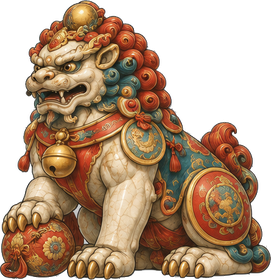
Bronze lions have guarded the Forbidden City's gates for six centuries. The largest pair stands before the Gate of Supreme Harmony: the male rests a paw on an embroidered ball, a sign of power over the world, and the female guards a cub. Guardian lions began in Buddhist art and became the emperors' own sentries.
The lion lifts his great head, and the bell at his collar rings once. The lion growls and shifts his weight. His paw stays on the ball. The lion bows his head over the ball and lets the plane through.
“I'd ask him what's inside the ball.”
-
The Boss
The Xiezhi
The beast of justice · Keeper of the Hall of Supreme Harmony
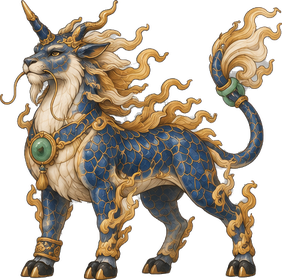
The Xiezhi is a one-horned beast of Chinese legend that could tell the guilty from the innocent and butted the liar with its horn. It rides the roof ridge of the Hall of Supreme Harmony, and the imperial censors, who watched over the emperor's officials, wore its image on their robes.
One horn lifts. The Xiezhi studies the plane as if checking it for lies. The Xiezhi snorts and paws the roof ridge, still watching. The Xiezhi lowers its horn to the roof and nods once.
“I'd tell it the truth, straight away.”
Beijing cleared. The temple roof was bluer than the sky.
- The lion kept his paw on the ball the whole time. I never found out what's inside.
- The Xiezhi looked straight through me. I was glad I'd told the truth.
The plane reaches Beijing from Tokyo. Clear it and the map opens the way to Bangkok and Hong Kong. Its own plane look is Willow Catkin, a trail look.