
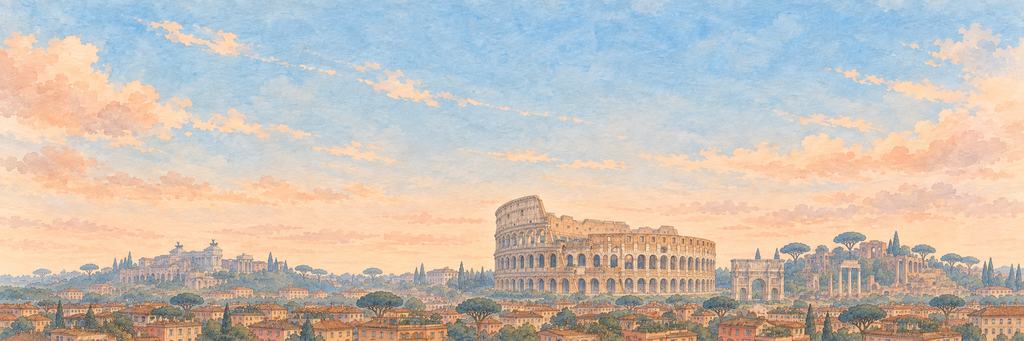
Rome paper plane game
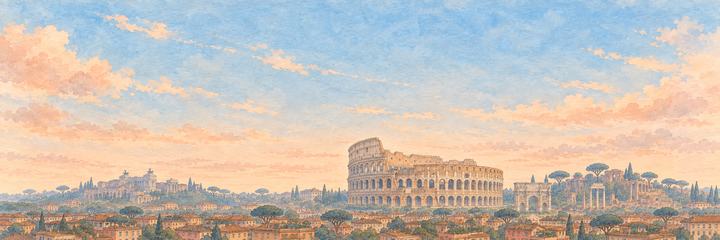
See the Colosseum, where crowds cheered two thousand years ago.
Nose up over the hills. Get past the Capitoline lion, then the gladiator.


Seven hills
Legend says Romulus founded Rome on the Palatine Hill in 753 BC. From a cluster of hilltop villages it grew into the capital of an empire around the Mediterranean, and by the 2nd century AD more than a million people lived there.
“I'd count the seven hills from the air.”
The landmarkThe Colosseum
The Colosseum opened in AD 80 with 100 days of games and held at least 50,000 people. On hot days, sailors from the navy's fleet at Misenum worked a vast canvas awning, the velarium, rigged from masts around the top, to shade the crowd.
Neighbourhoods
The historic centre of Rome is split into 22 old districts called rioni. Trastevere, number 13, lies on the west bank of the river. Its name comes from the Latin for "beyond the Tiber". South of the centre stands a hill made by people. Monte Testaccio is about 35 metres high and is built from the broken pieces of as many as 53 million Roman olive oil jars.
The river
The Tiber runs about 406 km from the Apennine mountains to the Tyrrhenian Sea, the third longest river in Italy. Inside the city lies Tiber Island, the only island on the river in Rome, shaped like a boat. The Ponte Fabricio, built in 62 BC, links it to the shore and is still largely the Roman bridge. After a great flood in December 1870, the city built tall stone walls along the banks, finished in 1926.
The skyline
Domes and bell towers rise above the rooftops. The tallest is the dome of St Peter's Basilica, designed by Michelangelo and finished in 1590, after his death. It rises 136.57 metres from the floor to the top of its cross. The Victor Emmanuel II Monument, finished in 1935, is built of bright white marble, and Romans call it "the wedding cake".
When to see it
Climb the Janiculum hill before noon. Every day at 12 o'clock a cannon fires a blank shot there, a custom begun in 1847 so the church bells could ring at the same time. At sunset, the Pincio terrace above Piazza del Popolo looks across the rooftops to St Peter's. In winter, huge flocks of starlings swirl over the Tiber at dusk.
Who keeps the wish in Rome.
An Elite wakes first; the Boss guards the wish itself. Hit their weak points for a BONK!, land the last blow for a KO!, and each one grins and takes a bow.
-
The Elite
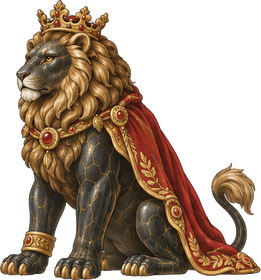
The Capitoline Lion
Pours water at the steps · Keeper of the Capitoline Hill
Two lions of black Egyptian basalt guard the foot of Michelangelo's great ramp up the Capitoline Hill, the hill at the heart of ancient Rome. They were carved in Egypt long before Rome ruled it, brought to the city in ancient times, and set at the steps in the 1500s, where they still pour water from their mouths.
The black stone lion lifts his crowned head and settles his cape. The lion shakes his mane and stays on the steps. The lion bows his crowned head and steps aside.
“I'd ask what the hill looked like before the steps.”
-
The Boss
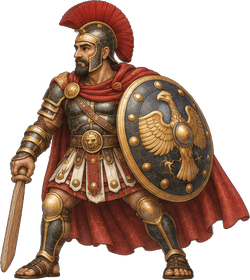
The Freed Gladiator
The man who won the wooden sword · Keeper of the Colosseum
In Rome's arenas a gladiator who fought well enough could win his freedom. As proof he was handed a rudis, a plain wooden sword. Some freed men, the rudiarii, chose to return to the arena as trainers and champions, and crowds cheered them by name.
The crowd's roar comes back to him. He lifts the wooden sword. He staggers, raises his shield and steadies. He lowers the wooden sword and bows his head. He is free.
“I'd ask him what the first free morning felt like.”
Rome cleared. I counted all seven hills.
- The lion never left the steps. I think he likes it there.
- The gladiator bowed with a wooden sword. It looked heavier than it was.
The plane reaches Rome from Cairo. Clear it and the map opens the way to Istanbul and Barcelona. Its own plane look is Rose Petals, a trail look.