
The Samba Dancer
Never misses a beat · Keeper of the Sambadrome
Deixa Falar, often called the first samba school, was founded in Rio in 1928. Today the schools parade through the Sambadrome, each with thousands of dancers.

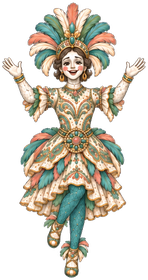
The legend
Deixa Falar, "Let Them Talk", often called the first samba school, was founded in Rio's Estácio neighbourhood in 1928 by musicians including Ismael Silva. Since 1984 the schools have paraded through Oscar Niemeyer's Sambadrome, each with thousands of dancers, drummers and towering floats.
“I'd dance the whole parade and never stop.”
Where it comes from
Samba grew in Afro-Brazilian communities of Bahia in the late 19th and early 20th centuries, from West African musical traditions and rural forms such as samba de roda. In Rio, Bahian families settled near the port, in an area the artist Heitor dos Prazeres called Pequena África, Little Africa. The home of a Bahian woman known as Tia Ciata became a meeting place for musicians. "Pelo Telefone", registered by Donga in 1916, is usually called the first recorded samba, though some scholars dispute it. The first samba school parade took place in 1932.
The keeper is inspired by the dancers of Rio's samba schools. A parade has set parts, many of them judged: a front group that opens the theme, a couple who carry the school's flag, the ala das baianas in wide round dresses, the floats, and a drum section of 250 to 300 players that sets the pace.
Where to see it
The parades fill the Sambadrome on the nights just before Lent. On the Saturday after Ash Wednesday, the top schools return for the Champions Parade, a celebration rather than a contest. In the weeks before Carnival, schools hold free rehearsals there. In Saúde, the old Little Africa, a samba circle has played on Monday nights since 2006 at Pedra do Sal, on steps where enslaved workers once unloaded salt.
In the game
The samba dancer starts to spin, feathers and all. The dancer loses a step, then finds the beat again. The dancer finishes the spin and takes a bow.