
The Capitoline Lion
Pours water at the steps · Keeper of the Capitoline Hill
Two lions of black Egyptian basalt guard the steps up Rome's Capitoline Hill. They were carved in Egypt long before Rome ruled it.

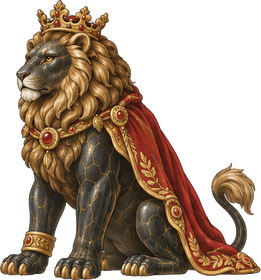
The legend
Two lions of black Egyptian basalt guard the foot of Michelangelo's great ramp up the Capitoline Hill, the hill at the heart of ancient Rome. They were carved in Egypt long before Rome ruled it, brought to the city in ancient times, and set at the steps in the 1500s, where they still pour water from their mouths.
“I'd ask what the hill looked like before the steps.”
Where it comes from
The lions most likely came from the Iseum Campense, Rome's most important Egyptian shrine, a temple to Isis and Serapis first built in the 1st century BC. In the mid-14th century they stood in front of the church of Santo Stefano del Cacco, which was built partly on the temple's remains.
In 1562 Pope Pius IV gave them to the people of Rome. They were moved up to the Capitoline and set on high plinths designed by Giacomo Della Porta. In 1587 the Acqua Felice aqueduct brought water to the hill, and the lions became fountains, with spouts in their mouths and a basin below each one. Chronicles say white and red wine flowed from them instead of water for the elections of Pope Innocent X in 1644 and Pope Clement X in 1670. In the late 19th century the originals were taken inside the Capitoline Museums and replaced by white marble copies. They came back to the steps in 1956.
Where to see it
The lions sit at the foot of the Cordonata, the broad ramp that climbs from Via del Teatro di Marcello to Piazza del Campidoglio. Michelangelo made it wide enough for riders to go up without leaving the saddle. At the top, marble statues of Castor and Pollux stand at the end of the railings.
In the game
The black stone lion lifts his crowned head and settles his cape. The lion shakes his mane and stays on the steps. The lion bows his crowned head and steps aside.