
The Palace Lion
Six hundred years at the gate · Keeper of the Forbidden City
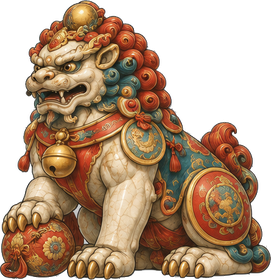
Bronze lions have guarded the Forbidden City's gates for six centuries. The male rests a paw on an embroidered ball, a sign of power over the world.
The legend
Bronze lions have guarded the Forbidden City's gates for six centuries. The largest pair stands before the Gate of Supreme Harmony: the male rests a paw on an embroidered ball, a sign of power over the world, and the female guards a cub. Guardian lions began in Buddhist art and became the emperors' own sentries.
“I'd ask him what's inside the ball.”
Where it comes from
Live lions reached the Han court as tribute from Central Asia and Persia; one record tells of a Parthian envoy who brought a lion and an ostrich in the year 87. The animals shown are believed to be Asiatic lions, but the carvers aimed to show the lion's spirit rather than its real shape. By the 6th century they were already popular as guardian figures.
In Chinese they are called shishi, "stone lions", though many are bronze, marble, granite or iron. In English they are sometimes called "foo dogs", a name that may come from confusion with Japanese guardian figures or Chinese dog breeds. A pair traditionally follows a set layout: seen from outside, facing the entrance, the male stands on the right and the female on the left. In some pairs the male's mouth is open and the female's closed, which is often read as the sacred syllable "om".
Where to see it
At the Gate of Supreme Harmony the male lion stands on the east side and the female on the west. Ming emperors once held morning court sessions at this gate. The gate burned in 1886, after a lamp tipped over in the guard room, and was rebuilt by 1894. Palace Museum tickets are sold online only, opening at 20:00 seven days before each visit.
In the game
The lion lifts his great head, and the bell at his collar rings once. The lion growls and shifts his weight. His paw stays on the ball. The lion bows his head over the ball and lets the plane through.