Greece
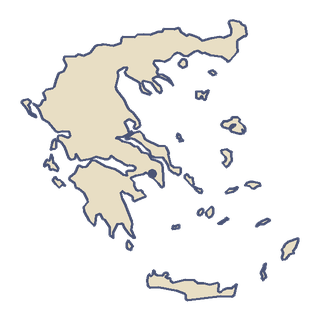
Greece lies at the south-east tip of Europe, where its mountains run down to the Aegean and Ionian seas. It has about 6,000 islands and islets, and people live on just over 200 of them. Its flag has nine blue and white stripes.
“I'd race Daedalus 88 across the sea to Santorini.”
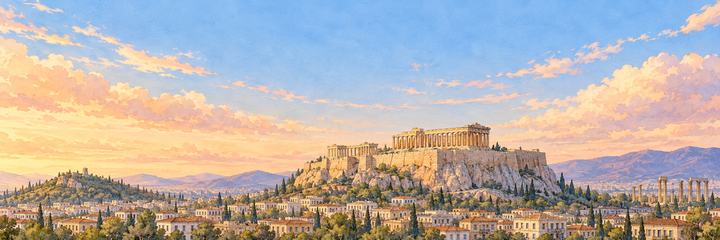
- On 8 February 1912 Emmanouil Argyropoulos made the first flight in Greece: sixteen minutes over Athens, right over the Acropolis.
- In 1988 Kanellos Kanellopoulos, a Greek cyclist, pedalled the aircraft Daedalus 88 from Crete to Santorini, 115 km over the sea.
The land
Greece covers about 131,957 km², and about 80 percent of it is mountains. Mount Olympus, home of the gods in the old myths, rises to 2,918 metres, the highest point in the country. With all its islands, Greece has about 13,676 km of coastline. Crete is the largest island.
Getting around
Piraeus, the port of Athens, is the largest passenger port in Europe. Ferries leave it for the Cyclades, the Dodecanese and many other islands. A railway from Piraeus to Thiseio, in Athens, opened on 27 February 1869. Today it is Line 1, the oldest line of the Athens Metro, running from the port north to Kifissia. The Corinth Canal, finished in 1893, cuts through the narrow neck of land between the Gulf of Corinth, on the Ionian Sea, and the Saronic Gulf, on the Aegean. It is 6.4 km long and only 24.6 metres wide at the water.
Food
In 2013 UNESCO listed the Mediterranean diet, shared by Greece and six other countries, as living heritage. Feta has been protected in the European Union since 2002. It is made from sheep's milk, or from sheep's milk with up to 30 percent goat's milk from the same area. It matures in brine for at least three months.
The capital
Nafplio, in the Peloponnese, was the capital of modern Greece until 1834, when King Otto moved the capital to Athens.