
The Sphinx
Dozing for 4,500 years · Keeper of Giza
Carved from Giza's bedrock some 4,500 years ago, the Great Sphinx lay buried to its shoulders in sand for centuries. A tablet between its paws says the prince who dug it free became king.
The legend
Carved from a single ridge of Giza's bedrock some 4,500 years ago, most likely for King Khafre, the Great Sphinx spent centuries buried to its shoulders in sand. A stone tablet between its paws tells how young Prince Thutmose dreamed it promised him the throne if he dug it free. He did, and became king.
“I'd ask him a riddle back.”
Where it comes from
The Sphinx is 73 metres long and 20 metres high, the oldest known monumental sculpture in Egypt. "Sphinx" is a Greek name, given about 2,000 years after it was carved. In Arabic it is Abu al-Hol, often explained as "father of terror", though that may be a folk etymology.
Its missing nose has a famous false story. Napoleon's soldiers did not shoot it off: the damage is recorded centuries earlier, and chisel marks show it was removed on purpose. The historian al-Maqrizi, writing in the 15th century, blamed a Sufi named Muhammad Sa'im al-Dahr, in 1378. Pieces of a carved royal beard were found between the paws, and some are now in the British Museum. Red paint survives on the face. Giovanni Battista Caviglia uncovered its chest in 1817.
Where to see it
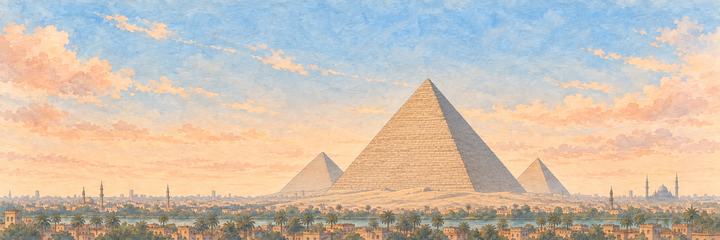
The Sphinx faces east on the Giza Plateau, beside the Sphinx Temple and the Valley Temple of Khafre. At the spring and autumn equinoxes the sun sets over its right shoulder. Egypt's antiquities ministry says it was placed that way on purpose; others think the builders simply used a limestone outcrop. At the June solstice, the sun sets between the pyramids of Khufu and Khafre. After dark, the Sound and Light show, held at the pyramids since the early 1960s, tells their story through the voice of the Sphinx.
In the game
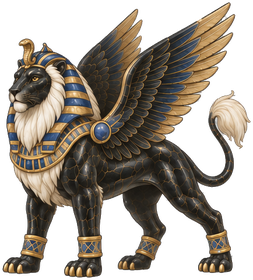
The Sphinx shakes the sand out of its wings. The Sphinx ruffles one wing and narrows its eyes. The Sphinx folds its wings, bows and settles into the sand.
Guards a relic: the Scarab Amulet. A gold scarab amulet from Cairo's old treasures, guarded by the Sphinx beside the desert road. It carries you further down that road.