
The Serpent of Erechtheion
Ate a honey cake every month · Keeper of the Acropolis
The Athenians left a honey cake each month for the serpent on the Acropolis. The year it stayed untouched, they took it as a warning and left the city.

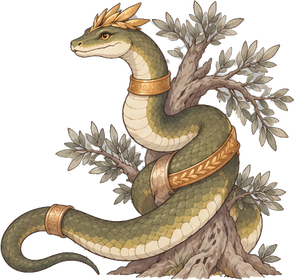
The legend
The ancient Athenians said a great serpent lived on the Acropolis and guarded it, and every month they left it a honey cake. In 480 BC, with a Persian army marching on Athens, the cake was found uneaten. The Athenians took it as a sign to leave, and they sailed their families to safety.
“I'd bring it a honey cake, just in case.”
Where it comes from
Athenians tied their sacred serpent to Erichthonius, one of the city's first kings. Athena gave the daughters of Cecrops a closed box and told them not to open it. They looked and saw a baby with a snake coiled round him, or a child half serpent. The sisters went mad and threw themselves from the Acropolis. In Athena's great statue in the Parthenon, Erichthonius was shown as a snake behind her shield.
The Erechtheion, built from about 421 to 406 BC, gathered many of these old cults under one roof. A crypt beneath its north porch held a pit for snakes. Inside the temple was a well of salt water, and marks in the rock were said to come from Poseidon's trident.
Where to see it
The Erechtheion stands just north of the Parthenon. Six stone women, the Caryatids, hold up its Porch of the Maidens. The ones there today are copies. The originals came down in 1979 to protect them from pollution, and five of them now stand on a balcony in the Acropolis Museum, where they can be seen from every side. The sixth was removed by Lord Elgin and is in the British Museum. Beside the temple grows an olive tree, where Athena's sacred olive was said to stand. The tree there now was planted in 1952 from a branch saved after the old tree was destroyed in the Second World War.
In the game
The serpent uncoils from its olive tree, lifts its crowned head and watches the plane, tongue flickering. The serpent's gold crown slips over one eye, and it tightens its coil around the tree. The serpent lowers its crowned head to the olive roots in a slow bow, and the plane flies on past the Parthenon.