
The Bronze Griffin
Guards gold it never spends · Keeper of the avenues
In Greek stories, griffins, half eagle and half lion, guarded gold. Greek bronze workers cast their heads to keep watch from the rims of great cauldrons.

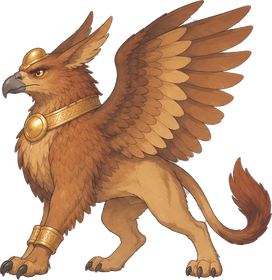
The legend
Greek storytellers said griffins, half eagle and half lion, guarded gold in the far north. Around 650 BC Greek bronze workers cast griffin heads with a knob on the brow and fixed them around the rims of great bronze cauldrons, beaks open, keeping watch on every side.
“I'd ask it where the gold is hidden.”
Where it comes from
The Greeks heard of gold-guarding griffins from Aristeas of Proconnesus, a 7th-century BC traveller. His poem is lost, but Herodotus retold its story of the Arimaspi, a one-eyed people on horseback who stole gold from the griffins. Aeschylus called griffins the "silent hounds of Zeus". The creature itself is far older than Greece. A winged, beaked lion appears on a seal impression from Susa in Iran from the 4th millennium BC, and a griffin was painted in the Throne Room at Knossos on Crete in the 15th century BC. The historian Adrienne Mayor has suggested that beaked dinosaur fossils seen by gold prospectors shaped the legend, but other scholars disagree.
More than 600 bronze griffin heads from cauldrons are known today. Most come from two great sanctuaries, Olympia and Samos.
Where to see it
The Paul and Alexandra Canellopoulos Museum, in a 19th-century mansion at 12 Theorias Street in Plaka, on the northern slope of the Acropolis, shows a bronze griffin head from the late 7th century BC, 15.8 centimetres high. The museum is closed on Tuesdays. One of the finest heads, found in a riverbed at Olympia in 1914, went missing and ended up in the Metropolitan Museum in New York. It was returned to Greece in March 2025 and now stands in the Archaeological Museum of Olympia, beside a similar head.
In the game
The griffin wakes with a snort, rears up on its hind legs, spreads its bronze wings and blinks one gold eye at the plane. The knob on the griffin's brow gives a bright, angry ring. It shakes its head and beats one wing. The griffin folds its wings, dips its beak low and steps aside for the plane.