Canada
Canada is the second-largest country on Earth. It stretches from the Atlantic to the Pacific and north into the Arctic, and it has more lakes than any other country. Its flag carries a red maple leaf.
“I'd fly the Silver Dart's way over the ice.”
- In 1909 J. A. D. McCurdy flew the Silver Dart over frozen Baddeck Bay: the first powered flight in Canada.
- Counting all its islands, Canada has the longest coastline in the world, more than 200,000 kilometres.
The land
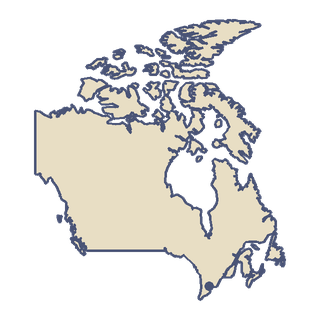
Canada has ten provinces and three territories, and more than 41 million people. Its border with the United States is the longest international land border in the world. About 80 percent of Canadians live within 150 km of that border. The land falls into seven natural regions, among them the Canadian Shield and the Interior Plains. Boreal forest covers much of the country. English and French are both official languages.
Getting around
The Trans-Canada Highway passes through all ten provinces. It opened in 1962 but was not finished until 1971. The train called The Canadian runs 4,466 km between Toronto and Vancouver, a trip of about four days. Toronto Pearson is the busiest airport in Canada, with 47.3 million passengers in 2025. Canada's first subway opened in Toronto on 30 March 1954.
Food
Canada makes more than 75 percent of the world's maple syrup, and Quebec makes about 90 percent of Canada's. The sap is gathered in late winter and spring and is often processed in a "sugar shack". In Toronto, the peameal bacon sandwich from St. Lawrence Market is often called the city's signature dish. Peameal bacon is credited to the pork packer William Davies, and his busy plant helped give Toronto its old nickname, "Hogtown".
Discoveries
Frederick Banting and Charles Best first isolated insulin in 1921 at the University of Toronto. On 11 January 1922 a 14-year-old boy got the first ever insulin injection at Toronto General Hospital.