Hong Kong
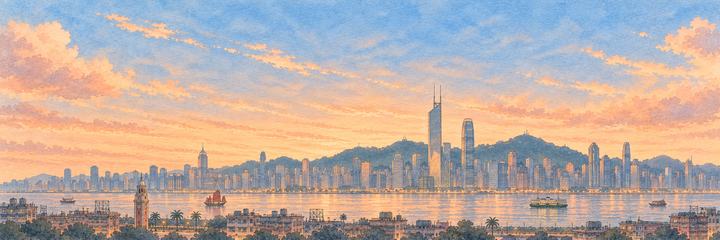
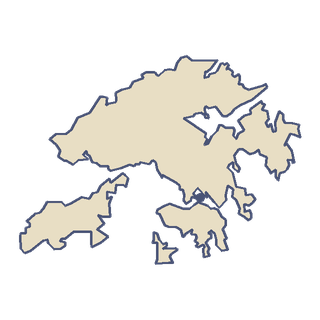
Hong Kong is a special administrative region of China, on the south coast where the Pearl River meets the sea. It is a peninsula and more than 250 islands, and most of its land is green hills and country parks.
“I'd have waved at the planes from a Kowloon roof.”
- Until 1998, airliners landing at the old Kai Tak airport made a sharp turn low over the rooftops of Kowloon.
- Hong Kong's new airport was built on Chek Lap Kok, an island that was flattened and made bigger to hold the runways.
The land
Hong Kong is one of two special administrative regions of China. The other is Macau, which Portugal handed over in 1999. Under the principle of "one country, two systems", Hong Kong keeps its own government and economic system, separate from mainland China. Its courts follow common law, carried over from British rule, and it has its own money, the Hong Kong dollar. About 7.5 million people live on 1,114 km² of land, one of the most crowded places in the world. The highest point is Tai Mo Shan, at 957 metres.
Getting around
The MTR, the metro and rail network, opened its first line on 1 October 1979. In 2023 its city lines carried about 1.6 billion passengers. The Octopus card, launched on 1 September 1997, was the world's second contactless smart card system. On Hong Kong Island, double-decker trams have run along the north shore since 1904. Locals call them "ding dings", after the bell.
Food
Yum cha, which means "drink tea" in Cantonese, is a breakfast or brunch of tea and dim sum. Small dishes come steamed in bamboo baskets and are shared at the table. Lin Heung Teahouse in Central, founded in 1889, still serves traditional dim sum.
Bridges
The Hong Kong–Zhuhai–Macau Bridge opened to the public on 24 October 2018. At 55 km, with an undersea tunnel and four artificial islands, it is the longest sea crossing in the world.