
The Stryge
The chimera of Notre-Dame · Keeper of the Île de la Cité
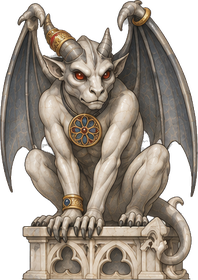
Le Stryge looks medieval, but it was set on Notre-Dame during a restoration begun in the 1840s. Its name comes from the strix, a night bird of Roman legend.
The legend
Le Stryge looks medieval but is younger: Viollet-le-Duc had the brooding chimera set on Notre-Dame's high gallery during his restoration, begun in the 1840s. The etcher Charles Méryon made it famous in 1853 and named it after the strix, a night bird of Roman legend.
“I'd sit beside him and watch the city.”
Where it comes from
Strictly speaking, the Stryge is not a gargoyle. A gargoyle is a carved spout that throws rainwater clear of the walls; the word comes from the French gargouille, linked to the word for throat. Carved figures without a spout are called chimeras. Notre-Dame has 54 of them, designed by Viollet-le-Duc for the restoration that ran from 1843 to 1864. They replaced sculpture destroyed during the French Revolution.
The etcher Charles Meryon (1821 to 1868) spent about ten years in the French navy before resigning in 1848. Colour blindness kept him to etching. The Stryge, from his series of Paris etchings made between 1850 and 1854, is his best-known print. It shows bats wheeling round the chimera above the Tour Saint-Jacques. His friend Baudelaire wondered how he could work so calmly "over an abyss". Meryon died in the Charenton asylum.
Where to see it
The Stryge sits on the Galerie des Chimères, up among the cathedral's towers. The towers reopened on 20 September 2025, for the first time since the 2019 fire. The climb is 424 stone steps with no lift, and tickets must be booked online in advance. From the top, at 69 metres, the view takes in Sacré-Cœur and La Défense. From April to October the towers stay open until 11pm, so the chimeras can be seen against the city lights.
In the game
High on Notre-Dame's gallery, the Stryge lifts its chin and turns to watch the plane. The Stryge flinches, then goes back to watching. The Stryge folds its wings, rests its chin in its hands and goes still.