
The Carousel Horse
Gallops all day and never leaves · Keeper of the Trocadéro
In 1662 Louis XIV held a riding festival by the Louvre where riders speared a hanging ring. The square is still called the Place du Carrousel.

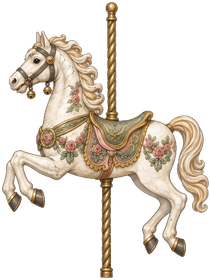
The legend
In June 1662 Louis XIV threw a horseback festival beside the Louvre so grand that the square is still called the Place du Carrousel. Riders galloped to spear a hanging ring with a lance. Tradition says wooden horses on a turning platform soon let anyone try, and the carousel was born.
“I'd ride the golden one and catch the ring.”
Where it comes from
The word carousel comes from the French carrousel, a "little battle", the name of the horseback tournaments of 17th-century Europe. The ring game is far older: Arab and Moorish horsemen of the 10th century speared rings hung from posts or trees, sometimes at full gallop. Late in the 17th century, wooden horses were hung from a wheel on a central pole, and a working horse walking round the edge turned it. Steam came in the 19th century. A steam roundabout built by Thomas Bradshaw appeared at a fair in Bolton, England, around 1861, and in 1880 the engineer Frederick Savage added the gears that make the horses rise and fall. In mainland Europe, carousels usually turn anticlockwise.
Where to see it
The Trocadéro carousel stands in the Jardin du Trocadéro, in the 16th arrondissement, with a clear view of the Eiffel Tower. It is built in an old style, with lanterns, painted panels and gilded trim. The oldest carousel still running in Paris is in the Jardin du Luxembourg. It opened in 1879, to designs by Charles Garnier, architect of the Opéra, and children on it still reach out to catch hanging rings. In Bercy, the Musée des Arts Forains keeps fairground rides from about 1850 to 1950; visits are by booking only.
In the game
The carousel horse opens one painted eye. The horse stumbles, then finds its gallop again. The horse rears once and comes to rest. The music stops.