
The Pearl River Pirate
Ruled the delta under a red sail · Keeper of Victoria Harbour
Around 1807 Cheung Po Tsai led the Red Flag Fleet, one of the largest pirate fleets in history. In 1810 he surrendered and became an officer in the Qing navy.

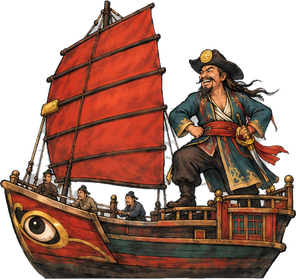
The legend
Around 1807 Cheung Po Tsai commanded the Red Flag Fleet, one of the largest pirate fleets in history, among the islands of the Pearl River Delta. In 1810 he surrendered to the Qing government and became an officer in its navy. On Cheung Chau island, a small cave is still said to hide his treasure.
“I'd look for his treasure cave, just in case.”
Where it comes from
Cheung Po Tsai was born in 1783 in Xinhui, in Guangdong. Around 1798, at about 15, he was taken by the pirate Cheng I, who with his wife Ching Shih adopted him as a stepson and heir. When Cheng I died suddenly in 1807, Ching Shih and Cheung Po Tsai shared power, and in 1810 they married.
When he gave up on 20 April 1810, he handed over about 280 ships, 2,000 guns and more than 25,000 men. In return he was given command of 30 ships and later a post on the Penghu islands. He died in 1822, still in his 30s.
Where to see it
The Hong Kong Maritime Museum, at Central Pier 8, shows a 19th-century painted scroll called "Pacifying the South China Sea" in its Sea Bandits Gallery. It shows the Qing navy's campaign against the pirates in 1809 and 1810, including a nine-day siege at Lantau and the surrender of Zhang Bao, leader of the red squadron. Zhang Bao is another spelling of Cheung Po Tsai's name. The scroll follows an account that strongly took the government's side, so it should be read with care. Beyond Cheung Chau, caves named after him are found on Lamma Island and Tap Mun, and he is linked to the Tin Hau temples at Stanley and Ma Wan.
In the game
The captain throws back his head and laughs, and his junk turns its painted eye on the plane. He staggers on the rolling deck and laughs it off. He bows grandly. The red sail drops behind him and knocks his hat sideways.