
The Oryx
Came home to the desert · Keeper of the dunes
Arabian oryx were wiped out in the wild by 1972. Herds bred in zoos were set free again, and oryx roam the desert once more.

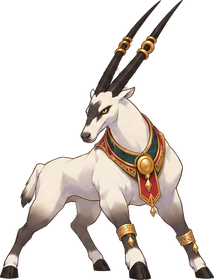
The legend
Arabian oryx are white antelope with long, straight horns, made for a desert with little water. By 1972 hunting had wiped them out in the wild. A few kept in zoos were bred into herds and set free again, and in 2011 the oryx became the first animal to climb from extinct in the wild back to vulnerable.
“I'd follow its tracks across the dunes.”
Where it comes from
The Arabian oryx stands up to 1.25 metres at the shoulder, and both males and females carry ringed horns up to 1.49 metres long. It can go several weeks without drinking. It rests in shade by day and feeds at night, cutting its water loss by at least half. It can also sense rain from far away and walk towards the fresh plants that follow.
Seen from the side, its two straight horns can look like one. Aristotle and Pliny the Elder thought the oryx was the model for the unicorn, and some think the myth began with oryx that had lost a horn.
The rescue began in 1962, when the Phoenix Zoo and conservation groups started the first captive herd with nine animals. The oryx is now the national animal of the UAE, and of Jordan, Oman, Bahrain and Qatar.
Where to see it
The Dubai Desert Conservation Reserve covers 225 square kilometres, nearly 5 percent of the emirate's land. Set up in the early 2000s around the Al Maha desert resort, it has the largest free-roaming herd of Arabian oryx in the UAE, along with Arabian and sand gazelles. The Al Marmoom Desert Conservation Reserve, the largest unfenced nature reserve in the country, covers about 10 percent of Dubai, includes the Al Qudra Lakes and has one of Dubai's largest oryx herds.
In the game
The oryx lifts its head high, its gold horn rings flash, and it stares straight at the plane. The oryx rears up on its hind legs, and its gold medallion swings. The oryx lowers its long horns to the ground in a slow bow.