
The War Elephant
Rings its bell before it sprays · Keeper of the Chao Phraya
For centuries the kings of Siam rode into battle on elephants. The Asian elephant is Thailand's national animal.

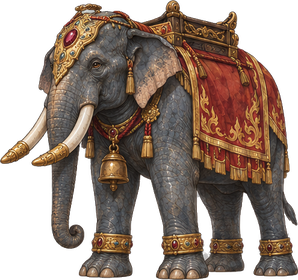
The legend
For centuries the kings of Siam rode into battle on elephants. The story goes that in 1593 King Naresuan won a duel on elephant-back against the Burmese crown prince, and Thailand still marks the day as Armed Forces Day. The Asian elephant is Thailand's national animal.
“I'd ride up top and ring the bell myself.”
Where it comes from
After Khmer power faded in the 15th century, Siam and Burma took up war elephants widely. On a royal war elephant, the king or general sat on its neck holding an ngaw, a long pole with a blade at the end and a metal hook for steering. Behind him a signaller passed on orders by waving a pair of peacock feathers, and a steerer sat at the back with another long pole. Above the signaller rose stacked round canopies, and their number showed the rider's rank. Siamese troops still rode elephants armed with large muskets until the war with France in 1893.
The elephant stayed a royal symbol. In 1855 King Mongkut gave Siam a flag showing a white elephant on a red ground. It was replaced by the red, white and blue stripes on 28 September 1917.
Where to see it
The Bangkok National Museum, founded in 1874, fills the old Front Palace facing Sanam Luang. Its Pritsadangkaphimuk Hall holds a collection of howdahs, the seats strapped to an elephant's back for travel and for battle, whose patterns showed the rank of the rider. The battle howdah is made of wood with gold leaf on black lacquer and coloured mirror glass. Large wooden leaf shapes around the seat are believed to have worked as shields, and poles at the corners held weapons.
In the game
The elephant raises its trunk, and the gold bell at its neck rings across the river. The elephant shakes its ears, and its bell clangs. The elephant kneels, lowers its trunk and rings its bell once, softly.