
The Fighting Fish
Flares at its own reflection · Keeper of the canals
Siamese fighting fish come from the rice paddies and canals of Thailand. A male spreads his fins wide to look bigger than any rival, even his own reflection.

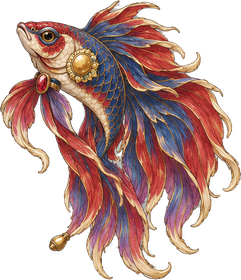
The legend
Siamese fighting fish, called plakat in Thai, come from the rice paddies and canals of Thailand. A male spreads his fins wide to look bigger than any rival, even his own reflection. For generations Thai breeders have raised them in brighter colours, and in 2019 Thailand named the fighting fish its national aquatic animal.
“I'd give it a mirror. Someone to argue with.”
Where it comes from
Pla kat means "biting fish". Wild ones are mostly green, brown and grey, with short fins, and show strong colours only when they are stirred up. They live in shallow, weedy water low in oxygen, so they have a special organ that lets them gulp air at the surface. A male blows a nest of bubbles on the water and guards the eggs in it until they hatch, 24 to 36 hours later.
DNA studies suggest people have bred these fish for at least 1,000 years. By the 19th century, fish fights were a betting game in Siam and the king taxed and controlled the matches. In 1840 the king gave some of his fighting fish to Theodore Cantor, a Danish doctor, who described the species in 1849. Today the wild fish is listed as Vulnerable, because its wetlands in central Thailand are being lost to towns and farms.
Where to see it
Pet stalls at Chatuchak Weekend Market sell fighting fish in sections 8, 9, 11 and 13. Across the Chao Phraya, on the Bang Kachao peninsula, the Thai Betta Museum has shown bettas and river fish in a Thai-style house since 2004. Take the ferry from the Khlong Toei side and walk about 500 metres. Entry is free, but listings disagree on its opening days, so check before going.
In the game
The fish flares every fin at once and glares at its reflection in the plane. The fish spins round in a swirl of red fins and flares again. The fish folds its fins, gives a small bow and swims off to sulk.