
The Kabuki Actor
Frozen in the fiercest pose · Keeper of Ginza
Kabuki began around 1603 with a dancer named Izumo no Okuni, on the dry bed of Kyoto's Kamo River. Since 1629, men have played every role.
The legend
Around 1603 a dancer named Izumo no Okuni began performing on the dry bed of Kyoto's Kamo River, in wild costumes that thrilled every class. Her art's name most likely comes from kabuku, to lean or to be outlandish. In 1629 women were banned from kabuki stages, and men have played every role since.
“I'd try his stomp and his big frozen pose.”
Where it comes from
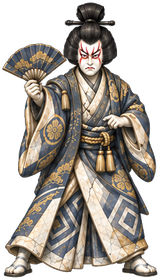
The frozen pose has a name: the mie. At a high point in the play, the actor stops and holds a striking pose to fix his character in the audience's mind. It is credited to Ichikawa Danjūrō I. In 1673, aged 13, he played the strongman Sakata Kintoki at Edo's Nakamura-za with his face striped in red and black. That was the first kumadori, kabuki's bold make-up, and the start of aragoto, the rough, larger-than-life style of Edo kabuki. The colours tell the audience who is who: red for heroes, blue or black for villains, green for the supernatural and purple for nobility. Danjūrō I died in 1704, stabbed by a fellow actor, Ikushima Hanroku. His sons and grandsons carried the Danjūrō name on.
Where to see it
The Kabuki-za, at 4-12-15 Ginza, is Tokyo's main kabuki theatre. It first opened on 21 November 1889, founded by the journalist Fukuchi Gen'ichirō. Fire, the 1923 Great Kantō earthquake and wartime bombing destroyed earlier buildings. The current theatre, by the architect Kengo Kuma, opened on 28 March 2013 and seats 1,964. A small number of single-act tickets on the 4th floor allow a visit to just one act. During a mie, expert fans shout the actor's house name, a custom called kakegoe. A raised walkway, the hanamichi, runs through the audience for grand entrances and exits.
In the game
The kabuki actor stamps once and freezes in a fierce pose. He staggers, snaps his fan open and holds the pose. The actor holds one last pose, then bows.