
The Great Hornbill
Wings like a steam train · Keeper of the Supertrees
Great hornbills live in the rainforests of Southeast Asia. Their wings beat so loudly that they sound like a steam train.

The legend
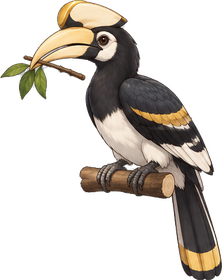
Great hornbills live in the rainforests of South and Southeast Asia. On top of their huge yellow bill sits a hollow helmet called a casque. Their wings beat so loudly that people compare the sound to a steam train. At nesting time the mother seals herself inside a hollow tree, and the father feeds her through a narrow slit.
“I'd plant a tree for its nest.”
Where it comes from
The great hornbill grows up to 130 centimetres long, its wings span more than 1.5 metres, and a big male can weigh 4 kilograms. It lives mostly on fruit, figs above all, and it spreads the seeds of many forest trees. The bright yellow of its bill and casque is not its own colour: the bird rubs on a yellow oil from a gland near its tail while preening. Males have red eyes and females bluish-white ones, and males sometimes butt casques in mid-air.
Great hornbills can live about 35 years in the wild and up to 50 under human care. Since 2018 the species has been listed as Vulnerable, threatened by forest loss and hunting. It is the state bird of Kerala and Arunachal Pradesh in India.
Where to see it
Great hornbills do not live wild in Singapore. The place to see one is Bird Paradise in Mandai, which opened in May 2023, replacing Jurong Bird Park. Its Winged Sanctuary holds the park's hornbills, and Sunny, a great hornbill, is the park's mascot. Singapore does have a smaller wild relative, the Oriental pied hornbill. Hornbills had died out on the island until a pair began breeding on Pulau Ubin in 1994. Nest boxes helped them spread, and they now turn up in parks on the mainland.
In the game
The hornbill hops along its branch, a twig for the nest in its beak, and eyes the plane. The hornbill flaps, nearly drops its twig and catches it again. The hornbill bows its big casque and flies home to its nest with the twig.